Burnout has been the number one topic in my coaching conversations lately.
The layoffs just keep coming, and AI is changing everything about how we work, how we search for jobs, and how we think about our professional value. The people I talk with tend to be in one of two places. Some are job searching and burned out. Others are still in a job that no longer fulfills them, and they're feeling burned out there, too.
The question that changed how I think about resilience
Back in 2020, during the pandemic, burnout was everywhere, for different reasons than it is now. I created a resilience training to help people understand their energy levels and how they could restore their energy.

It was a great training, and it helped a lot of people. But one person left a comment on it that still sits with me today. She asked:
"Is it really our job to stay resilient to conditions that make taking care of yourself almost impossible?"
At the time, I had an HR type of response. I told her it could be something she worked on with the help of her manager.
I don't think that response was wrong, exactly. But today, stepping back from all of my HR training and seeing how much burnout there is in our culture as a whole, I have a different perspective.
Is burnout at work your fault?
The World Health Organization describes burnout as resulting from chronic workplace stress that hasn't been successfully managed. I think that framing matters, because it puts burnout in context. Workload, leadership, staffing, and how much say people have over their own work all play a part.
So I'd answer her differently now. I'd tell her she was right to ask the question. No one should be expected to become resilient enough to compensate for workplace conditions that place high demands on people while giving them little control over how they meet them.
So I'd answer her differently now. I'd tell her she was right to ask the question. No one should be expected to become resilient enough to make up for conditions that make people feel powerless and need to change.
At the same time, I don't think that means our own resilience stops mattering. I think both things can be true. Organizations and their leaders are responsible for the conditions they create, and we can still build our capacity to take care of ourselves inside them.
What I've come to believe is that resilience works best when it gives us more room to choose. Sometimes that looks like resting and returning. Sometimes it looks like setting a boundary, asking for help, or naming what isn't working. And sometimes it looks like leaving.
Why resilience looks different for everyone
The Strozzi Institute looks at "sites of shaping," the different places that condition us and teach us how to live: our families, our cultures, our communities, our workplaces.
Each of those places can give us very different messages about what it means to take care of ourselves and prioritize our wellbeing. Maybe you grew up thinking it was selfish to take time for yourself. Or maybe you were taught to wear suffering as a badge of honor.
The messages we inherit from these sites of influence are part of why resilience looks so different from person to person. Coaching can help you unpack that conditioning so you can start to transform it.
Can you get better at resilience?
A common question I get in coaching is some version of: "I'm terrible at resilience. Is it really possible for me to change who I am?"
I think the answer is yes. Resilience is not who you are, but what you practice.
When you understand your patterns of conditioning, you can start to build your capacity and change your habits. And as you get clearer on your values and priorities, you know what you're working toward.
In Dare to Lead, Brené Brown explores resilience as something we can learn and practice, rather than a quality we either have or lack. Her work also emphasizes the importance of knowing our values and using them to guide our choices, particularly when things get difficult.
Like learning to ride a bike, swim, or speak another language, resilience gets easier with practice.
I've been working with clients who, through coaching, are defining their values and getting clear on the priorities they have outside of work. For some, that's friends. For others, it's volunteering or fitness.
Through this work, they're starting to practice putting their wellbeing first. They're managing their capacity and strengthening their internal resilience so that when life gets challenging, and it will, they have the resources in themselves to stay steady.
That doesn't mean they don't get stressed or worried or upset. It just means they know how to get back to their place of balance.
Here's how I think about noticing your own capacity and finding ways to restore it:
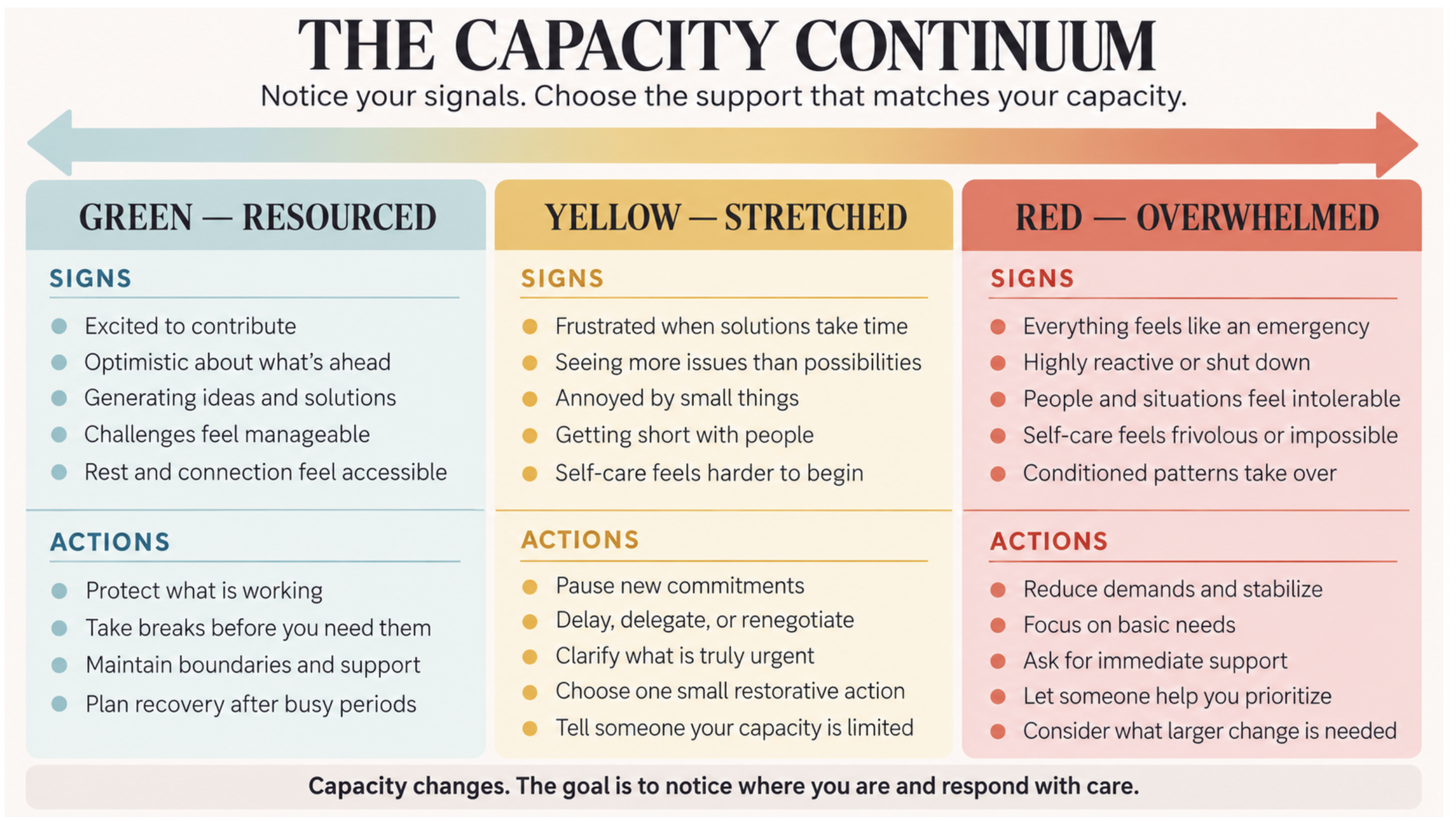
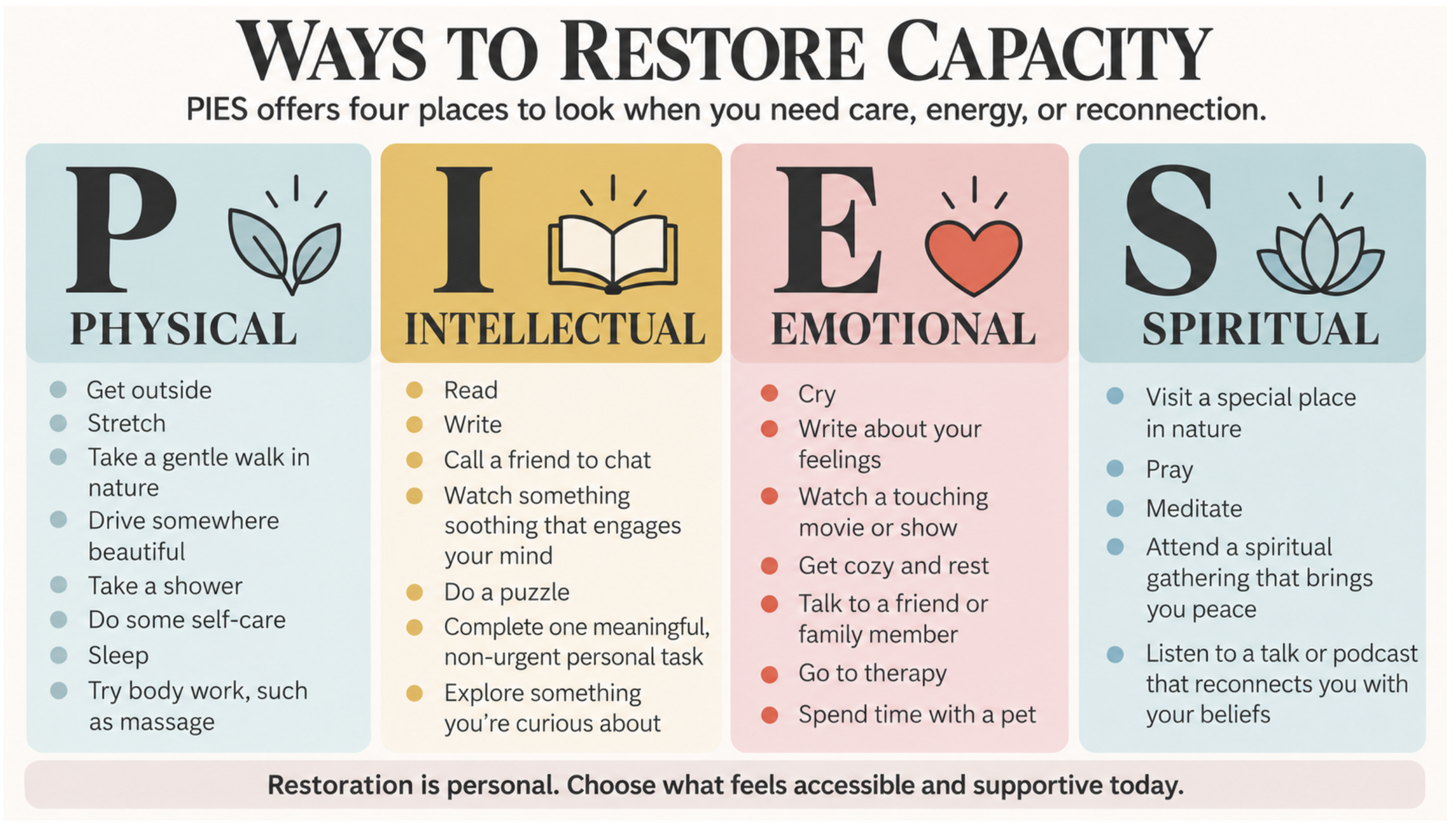
As the model says, the goal isn't to stay green all the time. It's to notice where you are and respond with care. The PIES model gives you options for restoring your capacity - note which need is strongest and what activities are most restorative for you.
Who is your resilience for?
So how do I view resilience now, a few years removed from both the pandemic and my corporate life?
I used to think of resilience as a means to an end. If I had enough resilience, I'd be better at my job and more valuable to the company I worked for.
Now I've come to see that resilience is just for me. It's what brings me the peace and contentment I'm worthy of receiving, whether or not it makes me more likable or more employable.
That's what I wish I'd said to the person who asked me that question back in 2020.That's what I wish I'd said to her.
So my invitation to you is this: if resilience were just for you, something that protects you, your energy, and your peace rather than something you do to be more efficient or effective, what would it look like?
I'm genuinely curious what that looks like for you.
And if you'd like to explore that question alongside other people who are asking it too, I'm creating a space for that.

Want to practice resilience alongside others?
I'm putting together a small resilience cohort for people who want to practice this together. If you'd like to hear first when it opens, let me know and I'll make sure you're included.
recent posts


About the Author • Richelle Safe
Richelle Safe is a leadership coach and founder of Coral Coaching. After 15 years advising leaders at Amazon, Meta, and Netflix, she knows there’s a whole person behind every leadership title. Her coaching is curious, direct, and deeply human, helping leaders challenge old patterns, see new possibilities, and move forward with greater clarity and intention.
Curious what coaching could look like for you?
BOOK A FREE CONSULTATION