
There’s an example I’ve used in leadership training that gets at something I’ve seen play out over and over again in much higher-stakes situations. Imagine someone is giving a presentation with their pants unzipped. Everyone in the room notices, but nobody says anything. In the moment, staying quiet can feel like the kind choice. You don’t want to embarrass them or make an already uncomfortable situation worse.
But if you were the person giving the presentation, you’d probably want someone to quietly pull you aside and tell you. Finding out later that everyone noticed and nobody said anything wouldn’t feel particularly kind. You might wonder why no one had your back enough to say something.
I come back to this example because I’ve seen leaders do versions of it throughout my career. They avoid giving difficult feedback because they care about the person and don’t want to hurt them. They soften an expectation until it isn’t particularly clear anymore. They wait and hope a problem will resolve itself. Or they assume someone “should know” what needs to change without ever actually telling them.
I understand the instinct. Difficult conversations are uncomfortable, especially when you genuinely care about the person on the other side of them. But avoiding the conversation usually doesn’t make the problem go away. It just means the other person doesn’t have the information they need to do anything differently.
Clear is kind. Unclear is unkind.
This is language I come back to often in my coaching, and it comes from Brené Brown’s work on courageous leadership. Brown writes about the ways we sometimes avoid clarity because we tell ourselves we’re being kind, when what we may really be avoiding is our own discomfort. The problem is that people can’t meet expectations they don’t understand, and holding someone accountable later for something we never clearly communicated isn’t particularly fair.
What I appreciate about this idea is that it leaves room for nuance. “Clear is kind” doesn’t mean saying whatever you think without considering how it will land. Being blunt isn’t the same thing as being honest, and being direct doesn’t require us to stop being empathetic.
After 15 years working alongside leaders and teams, first as an HR partner at Amazon, Meta, and Netflix and now as a leadership coach, I’ve seen leaders struggle with this from both directions. Some care so deeply about people that they hesitate to challenge them. Others think they’re being direct when they’re actually avoiding the conversation until their frustration comes out in ways that aren’t particularly helpful.
Those may look like very different leadership problems, but I think there’s often something similar underneath them: the real conversation hasn’t happened.
When empathy makes direct feedback harder
I once worked with a leader I’ll call Elisabeth, who led a highly cross-functional team of designers. Her senior individual contributors had a significant influence on the culture of the broader team, and they were thoughtful, highly empathetic people. That empathy was one of the team’s strengths, but I started to notice that it could also make direct feedback difficult.
People were sometimes going years without hearing feedback about behaviors that weren’t working. Everyone cared about maintaining strong relationships, but that care had started to make it harder to say the things that might actually improve those relationships.
Elisabeth saw the pattern, too. During our one-on-one conversations, I would give her space to talk through her frustrations, and then I’d gently bring her back to the same idea: clear is kind, unclear is unkind. What do you want to do about it?
At first, she kind of hated hearing it.
But she started having the conversations. And what I found interesting was that the empathy that had made direct feedback difficult for her also became one of her greatest strengths once she started giving it. She cared deeply about the people she was talking to, so she delivered the feedback with a lot of thoughtfulness and support.
She started seeing changes she hadn’t thought were possible. Over time, she needed less and less of my help preparing for those conversations. Eventually, she asked me to coach her direct reports so they could start doing the same thing with their own teams.
What changed wasn’t that she became less empathetic. She learned that empathy and directness could exist in the same conversation.
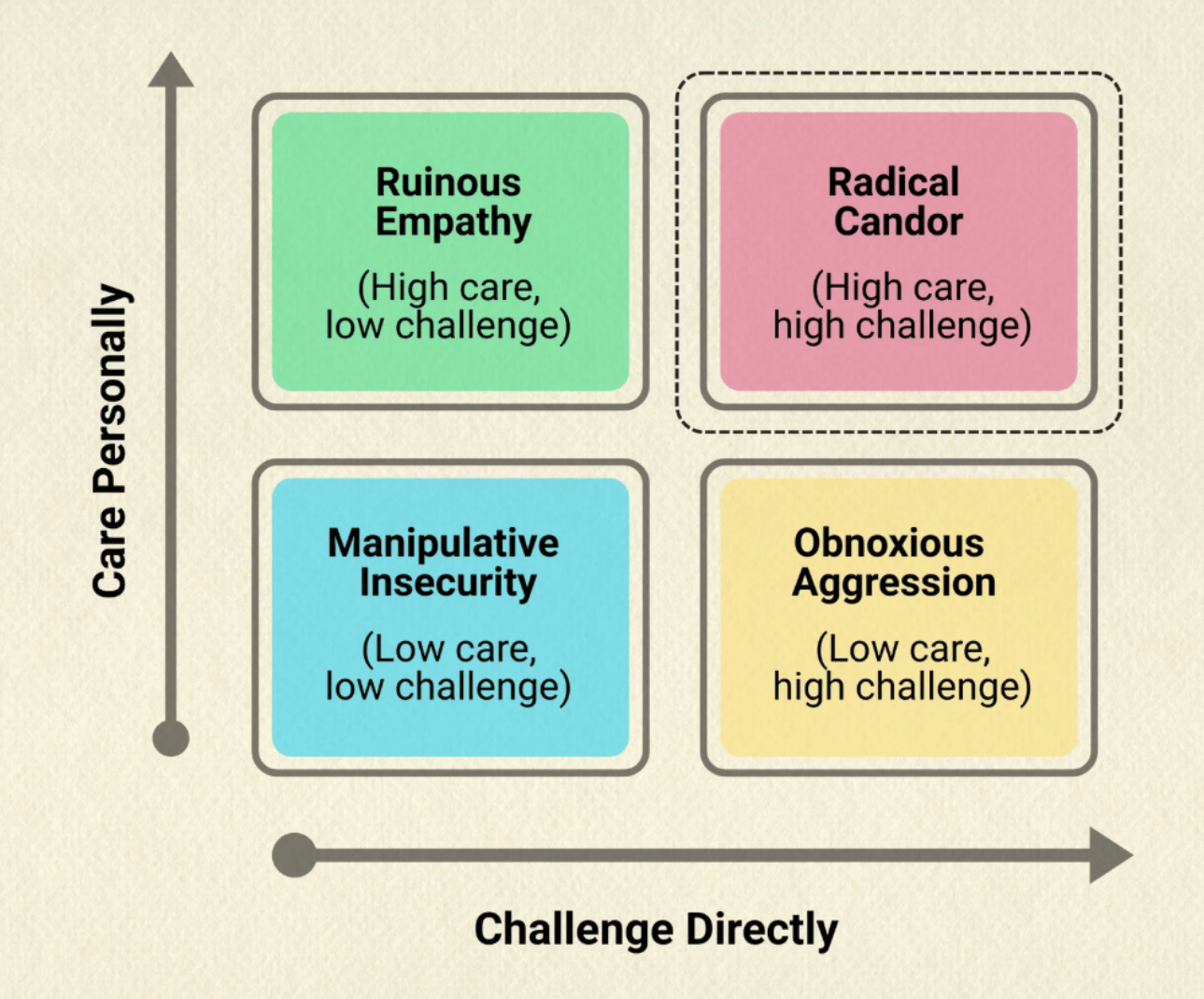
That’s one reason I also find Kim Scott’s Radical Candor framework useful. Scott describes effective leadership as the combination of caring personally and challenging directly. I think that distinction helps because it moves us away from the idea that leaders have to choose between caring about people and telling them something difficult. The best leaders learn how to do both.
Being harsh isn’t the same as being direct
I’ve seen the opposite pattern more times than I can count. A leader thinks they’re being tough because they give harsh feedback publicly, or they’re ready to let someone go because that person isn’t meeting expectations.
When that happens, one of the questions I’ll ask is:
What would your team member tell me about the feedback you’ve shared with them?
I’ve had leaders kind of stumble through the answer and eventually admit some version of, “Well, I haven’t actually told them.”
Meanwhile, the leader may have been frustrated for months. They’ve thought about the problem, talked about it with other people, and reached the point where the issue feels incredibly obvious to them. But the person they’re frustrated with hasn’t been part of those conversations.
I don’t think that’s direct leadership. The difficult conversation is still being avoided. It’s just showing up differently.
I’ve had a few situations where I’ve sat with leaders and their team members and helped them work through the feedback directly and with more care. One of the things that has stayed with me is how quickly people can be willing to change their behavior once they actually understand what isn’t working and have the opportunity to respond.
That doesn’t mean every difficult conversation leads to change. Sometimes expectations have been communicated clearly and someone still isn’t meeting them. Sometimes a leader does need to make a hard decision. But I think people deserve the chance to understand what’s expected of them before they’re held accountable for not meeting that expectation.
Sometimes clarity starts with listening
There’s another part of this that I think is important. Being clear isn’t only about getting better at telling people what you need from them. Sometimes you need to get curious about what you haven’t been hearing.
I worked with another leader who ran a highly operational workplace team where there was a lot of drama and swirl. She had started to take on something of a parent role with the team. When things went wrong, she felt like it was her job to reprimand people and correct the behavior.
Over time, the team started distancing themselves from her, and an us-versus-them dynamic developed between the team and leadership.
When we worked together, we focused on helping her find a leadership voice that felt more authentic to her. Part of that meant getting much clearer about what she actually needed from the team and communicating those expectations directly. But it also meant creating space for her to understand what was happening from their perspective.
She decided to do a listening tour, spending one-on-one time with people across the team and listening to their concerns. That helped her see more of what was underneath the dynamics she had been reacting to and gave her a different way to engage with the team.
For her, “clear is kind” wasn’t really about giving harder feedback. It was about being clearer about what she expected while also being willing to listen to what the team needed her to understand.
I think that part matters. A difficult conversation isn’t just an opportunity to deliver a message. It’s also an opportunity to learn something you may not know yet.
A question I come back to with leaders
If you’re frustrated with someone on your team or there’s a conversation you’ve been putting off, I’d start with the same question I ask leaders in coaching:
What would this person tell me about the feedback you’ve given them?
Try to answer it from their perspective. Would they be able to explain what you need from them, what isn’t working, and what you’re asking them to do differently? Or are you assuming they understand something you haven’t actually said?
If you realize they probably don’t know, that’s useful information. You may not need a tougher conversation. You may just need a clearer one.
Before you have it, I’d think about a few things:
Have I actually been clear? Could this person explain back to me what I need from them and what I’m asking them to change?
What is my intention going into this conversation? Am I trying to help this person understand something important, or am I mostly frustrated and looking for somewhere to put that frustration?
What might I not understand yet? What could I learn if I go into the conversation prepared to listen as well as talk?
How can I be both direct and caring? What would it look like to tell the truth clearly while still treating the person in front of me like a person?
In my experience, leaders who get better at these conversations don’t necessarily become tougher. They become clearer, and I think that makes them easier to trust. Their teams have a better understanding of where they stand, people have the opportunity to respond to feedback before frustration builds, and difficult conversations can happen earlier, when there’s still time to work through what needs to change.
That’s what “direct is kind” means to me. Not brutal honesty. Not avoiding someone’s feelings. Being willing to say what needs to be said, with enough clarity and care that the other person can actually do something with it.

Still figuring out how to have a difficult conversation?
Leadership coaching can give you space to think through what you want to say, what might be getting in the way, and how you want to approach the conversation.
recent posts


About the Author • Richelle Safe
Richelle Safe is a leadership coach and founder of Coral Coaching. After 15 years advising leaders at Amazon, Meta, and Netflix, she knows there’s a whole person behind every leadership title. Her coaching is curious, direct, and deeply human, helping leaders challenge old patterns, see new possibilities, and move forward with greater clarity and intention.
Curious what coaching could look like for you?
BOOK A FREE CONSULTATION